Ph.D.
I received my Ph.D. from the Ohio State University in 2014.
I spent most of my Ph.D. taking econometrics courses - probability theory, regression, maximum likelihood estimation, time series models, event history models, spatial econometrics, panel data analysis, scaling and dimensional analysis - and independently learning machine learning, language models, and Python. I also took courses on research design, survey design, game theory, and political science (I was in the political science department).
For my dissertation I used language models and 42 million news articles from more than 6,000 sources in order to build the first machine-coded democracy index. You can read my dissertation here.
(Fun fact: I scraped all those news articles from a repository called LexisNexis, they got upset about it, so I wrote a comprehensive tutorial on how to scrape LexisNexis and it became quite popular at the time - part 1, part 2, part 3, part 4, part 5. It was my little tribute to Aaron Swartz.).
teaching
After my Ph.D. I taught statistics and machine learning at different universities and research institutions - the University of Brasília, IESB, IDP, and IPEA -, both undergraduate and graduate courses. You can find some of my syllabi, slides, etc here.
I have served on undergraduate and graduate thesis committees at the University of Brasília and at the FGV.
publications
I wrote a chapter in the edited book Non-Academic Careers for Quantitative Social Scientists (Springer, 2023).
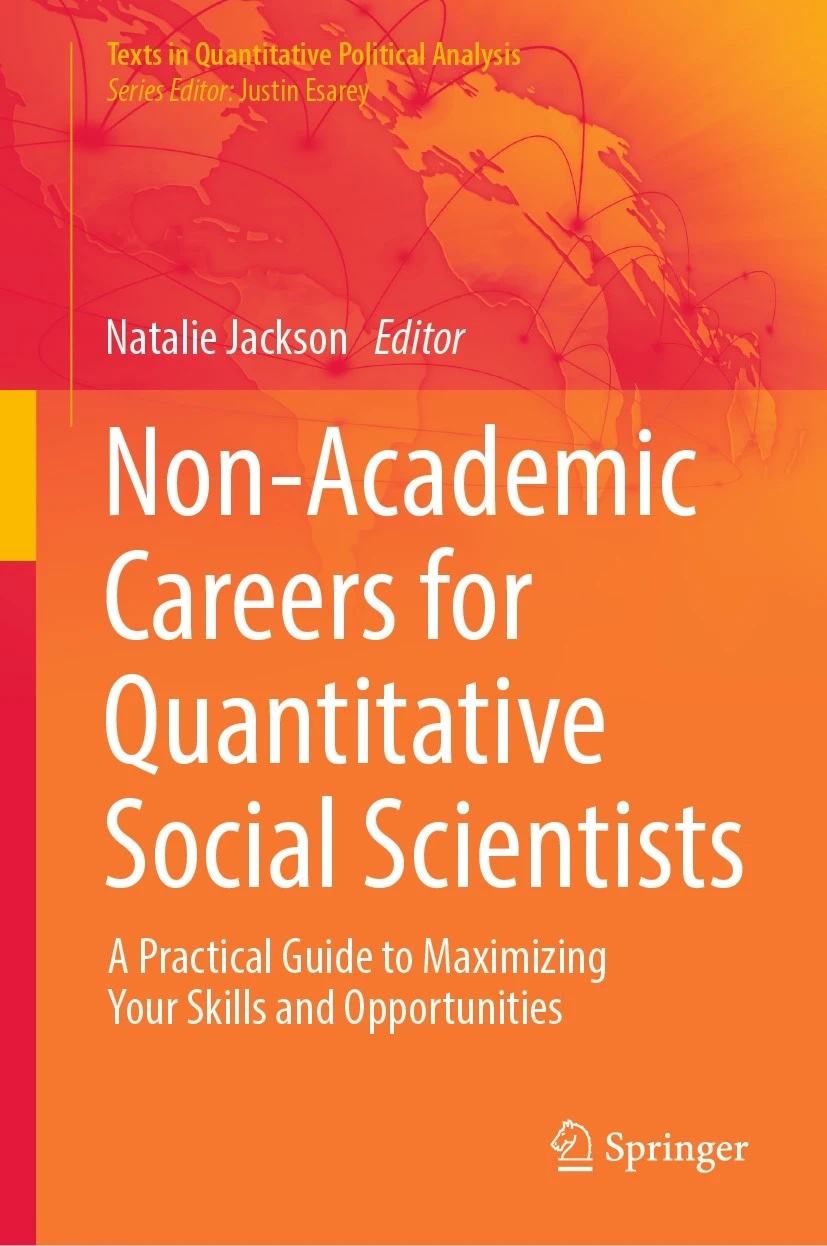
(Relatedly, I’m always open to talking to quant people who aren’t sure academia is for them. Just email me and we’ll chat.)
I have published peer-reviewed articles on sports science, econometrics, economics, political science, and fraud detection:
-
Predictors of long-term resistance exercise adherence: Evidence from a large cohort of mobile app users of various experience levels. (with Federica Conti, Brad Schoenfeld, and Andy Galpin). Frontiers in Sports and Active Living, 8, 2026.
-
A note on real estate appraisal in Brazil. (with Rodrigo Peres and Leonardo Sales). Brazilian Review of Economics, 75(1), 29-36, 2021.
-
Automated Democracy Scores. Brazilian Review of Econometrics, 37(1), 31-43, 2017. This paper is the core of my Ph.D. dissertation.
-
Deep Learning Anomaly Detection as Support Fraud Investigation in Brazilian Exports and Anti-Money Laundering (with Ebberth Paula, Marcelo Ladeira, and Rommel Carvalho). 15th IEEE International Conference on Machine Learning and Applications (ICMLA), 2016.
-
A dimensão geográfica das eleições brasileiras (“The spatial dimension of Brazilian elections”). Opinião Pública (Public Opinion), 19(2), 270-290, 2013.
-
Lobby e protecionismo no Brasil contemporâneo (“Lobby and protectionism in Brazil”). Revista Brasileira de Economia (Brazilian Review of Economics), 62(3), 263-178, 2008.
And some papers that never got past peer-review but that I stand by: